A gentle note: This article is general information about mental health, not medical advice, diagnosis, or treatment. Everyone's relationship with themselves is different. If self-criticism feels constant, or comes alongside persistent low mood, please reach out to a licensed mental-health professional. If you ever feel unsafe or in crisis, contact your local emergency services or a crisis helpline right away.
You make a small mistake at work and the voice starts immediately: of course you did, you always do this. A friend cancels and somehow you decide it's your fault. You'd never speak to someone you love the way you routinely speak to yourself — and yet the harsh commentary feels normal, even necessary, as if being tough on yourself is the only thing keeping you in line.
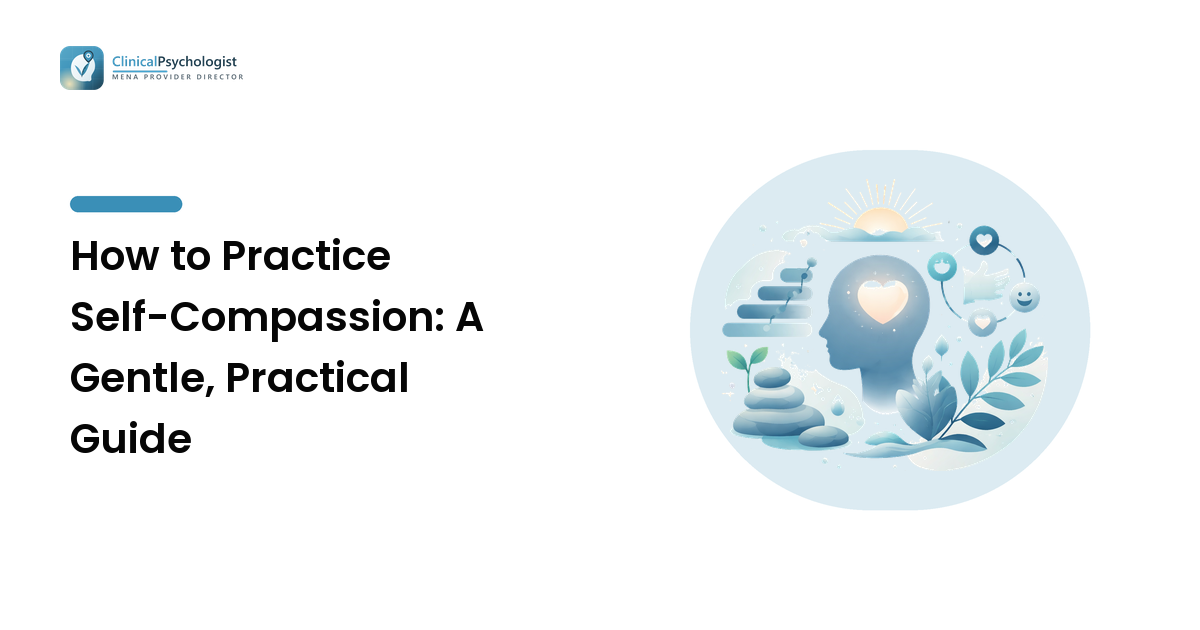
Here's the takeaway up front: self-compassion is simply treating yourself with the same warmth and honesty you'd offer a good friend who was struggling. It is not self-pity, it is not lowering your standards, and it is not letting yourself off the hook. In fact, the evidence points the other way — people who are kinder to themselves tend to recover from setbacks faster and keep trying, because they aren't spending all their energy defending against their own inner critic. Kindness, it turns out, is not the opposite of motivation. Often it's the fuel.
What self-compassion actually is (and isn't)
Psychologist Kristin Neff, whose research helped bring this idea into the mainstream, describes self-compassion as having three parts that work together. It's a useful map, so let's borrow it.
Self-kindness instead of harsh self-judgement — meeting your own struggles with warmth rather than a running critique. Common humanity instead of isolation — remembering that failing, hurting, and falling short are part of being human, not proof that you alone are defective. And mindfulness instead of over-identifying with your thoughts — noticing painful feelings clearly without either suppressing them or being swept away by them.
It helps just as much to name what self-compassion isn't, because the myths are what usually stop people.
- It isn't self-pity. Self-pity says poor me, no one has it as bad as I do and shrinks your world down to your own suffering. Self-compassion does the opposite: it connects your struggle to everyone else's. You are not uniquely broken; you are human, having a human moment.
- It isn't making excuses. You can fully acknowledge that you messed up and speak to yourself with kindness while you fix it. Warmth and honesty are not enemies. "That didn't go well, and I can put it right" is both compassionate and accurate.
- It isn't a reward you earn. You don't have to achieve something to deserve basic kindness from yourself. It's the baseline, not the prize.
Why being hard on yourself backfires
Most of us cling to the inner critic because we're quietly afraid that without it, we'd fall apart or stop trying. It's worth questioning that assumption, because it usually doesn't hold up.
When you attack yourself for a mistake, your body responds much as it would to any threat — a stress reaction, a flood of self-consciousness, a strong urge to hide or defend. That state is terrible for learning. It's hard to look honestly at what went wrong when part of you is bracing against a verbal beating. So the harshness that's supposed to sharpen you often does the reverse: it makes you avoid the very thing you're anxious about, procrastinate to dodge the critic, or give up because trying feels too exposing.
Self-compassion changes the internal weather. When it's safe to acknowledge a mistake — because you know you won't be savaged for it — you can actually see it, own it, and adjust. This is also why self-compassion tends to hold up better than self-esteem. Self-esteem often depends on feeling special or above average, which quietly collapses on the days you fail or compare badly. Self-compassion doesn't need you to be exceptional. It's there precisely because you're struggling, which is exactly when you need it most.
Simple ways to practise, starting today
Self-compassion is a skill, not a personality trait you either have or don't. Like any skill, it grows with small, repeated practice. Here are gentle places to begin.
1. Use the "good friend" test
The fastest way in: when you catch the harsh voice, pause and ask, what would I say to a friend I love who was in this exact situation? You'd almost never say you're pathetic, everyone can see it. You'd say something warmer and more useful — that's a tough spot, and it doesn't define you. Then try, awkward as it feels, offering that same sentence to yourself. You are as deserving of that tone as anyone.
2. Name the moment of struggle
Neff suggests a short three-part phrase you can say quietly to yourself in a hard moment, and it maps neatly onto those three ingredients: This is a moment of struggle (mindfulness — you're naming the pain rather than drowning in it). Struggle is part of being human (common humanity — you're not alone in this). May I be kind to myself right now (self-kindness — a small, deliberate turn toward warmth). It can feel stiff the first few times. Do it anyway; the point is to interrupt the automatic pile-on.
3. Change how you talk to yourself
Notice the actual words your inner critic uses, then experiment with a gentler, honest rewrite. I'm such an idiot becomes I made a mistake, and mistakes are how people learn. I always ruin everything becomes this went badly, and that's painful — one hard day isn't the whole story. You're not lying to yourself or slapping on forced positivity. You're aiming for the truth, said kindly.
4. Offer yourself a small physical kindness
Emotions live in the body, not just the mind. A hand placed gently on your own chest, a slow breath, unclenching your jaw and shoulders — these small gestures send a genuine signal of safety and care, and they can soften a spiral faster than arguing with your thoughts ever will. If your mind tends to loop and replay in these moments, our guide on how to stop overthinking pairs well with this.
5. Write yourself the letter you need
When something is weighing on you, try writing a short note to yourself from the perspective of an unconditionally kind friend — someone who sees your flaws clearly and cares about you anyway. What would they want you to know? Reading it back, in your own handwriting, can reach places that thinking alone can't.
When self-kindness feels impossible
For some people, turning kindness inward doesn't feel soothing at first — it feels uncomfortable, undeserved, even a little threatening. That's more common than you'd think, especially if criticism is what felt familiar or safe growing up. If that's you, go gently and small. You don't have to summon deep self-love; you only have to be slightly less harsh than usual, one moment at a time. Neutral is a fine place to start — swapping I hate that I did that for a plain that happened is real progress.
And please hear this clearly: self-compassion is a supportive daily practice, not a treatment. If self-criticism is relentless, if you often feel worthless, or if it comes wrapped in persistent low mood, anxiety, or hopelessness, that deserves proper support. A licensed mental-health professional can help you understand where the harsh voice came from and work with it in ways a single article never could. Reaching out isn't a failure of self-compassion — it's one of its truest expressions.
Being kind to yourself won't make you soft, lazy, or complacent. It makes you steadier — someone who can face a hard day, own a mistake, and keep going without first surviving an attack from within. You already know how to extend that kindness; you do it for the people you love all the time. This is simply learning to turn a little of it back toward yourself. You're allowed to. Start with one sentence.